The MDC_BOD is a body laid out the way DATCOM lays one out: a nose, a
centerbody and an aft body, each given by its shape, its length and its
size at its aft end, and closed by a flat base. The controls carry the
names and meanings of the inputs of DATCOM's AXIBOD and ELLBOD
namelists, so a DATCOM body can be entered as it is written, and a body
described by few numbers can be changed quickly. Choose the AXIBOD form
for a body of circular sections, and the ELLBOD form for elliptical
ones. Only DATCOM's first way of describing a body, by nose, centerbody
and aft body, is available; a body given by stations is a Fuselage or Stack, and the MDC_BOD can be
converted to a Stack (see Convert to Stack). The script
datcom2vsp.py, in the examples, reads a DATCOM input file
and builds a model from its body, protuberances, fin sets and inlets,
using this component and the MDC_PROTUB, MDC_FIN and MDC_INLET
components.
The MDC_BOD has one tab of its own, Design. The Gen, XForm, Mass and Sub tabs are described on their own pages. The Design tab sets
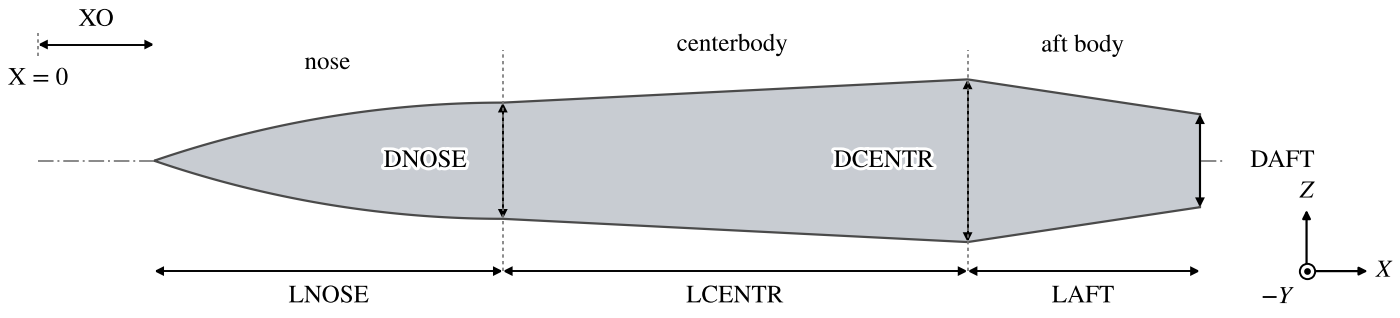
The nose runs from its tip, at the component's origin, a LNOSE aft to the nose base. The centerbody runs a further LCENTR, and the aft body a further LAFT, ending at the base (Figure 1). Each part has one size, its diameter (AXIBOD) or width and ellipticity (ELLBOD), given at its aft end by DNOSE, DCENTR and DAFT, or by the widths and ellipticities of ELLBOD. The body runs straight between these stations, so a centerbody whose DCENTR differs from DNOSE is a cone frustum, and one that keeps the nose's size is a cylinder. The aft body is a boattail where DAFT is smaller than DCENTR, and a flare where it is larger. The base is flat.
Figure 1. A body with an ogive nose, a tapering centerbody and a boattail, with the lengths and diameters that set them.
A part with no length is left out. A LCENTR of zero joins the aft body to the nose base, and a LAFT of zero, its default, leaves the body with no aft body, ending at the centerbody. With both zero the body is the nose alone, closed by a flat face at its base. The inputs of a part that is left out are greyed in the Design tab, as are the inputs of the namelist not chosen and the inputs that shape nothing in the nose.
XO is where the nose tip is along : it is the X location of the XForm tab, shown again on the Design tab, so it moves the whole body without changing its shape. The XForm tab moves and rotates the body as it does any component, turning it about the point along its length that the XForm tab's Origin gives as a fraction of the body's length from the nose tip.
The Preset choice and its Set button give the body a whole shape:
every input of the Design tab is set, and the body keeps its place.
Choosing a preset changes nothing until Set is pressed. Default is the
body as new. Generic Rocket is a body 175 long and 10 across: a Von
Karman nose 30 long, a cylinder 142 long and a conical boattail 3 long
to 9 across. The API call SetMdcPreset does the same.
In DATCOM the centerbody's size defaults to the nose's. With Nose's size on, the default, DCENTR is DNOSE and WCENTR is WNOSE, and they follow the nose when it changes. Turn it off to give the centerbody a size of its own.
The nose is one of five shapes, chosen by TNOSE (Figure 2).
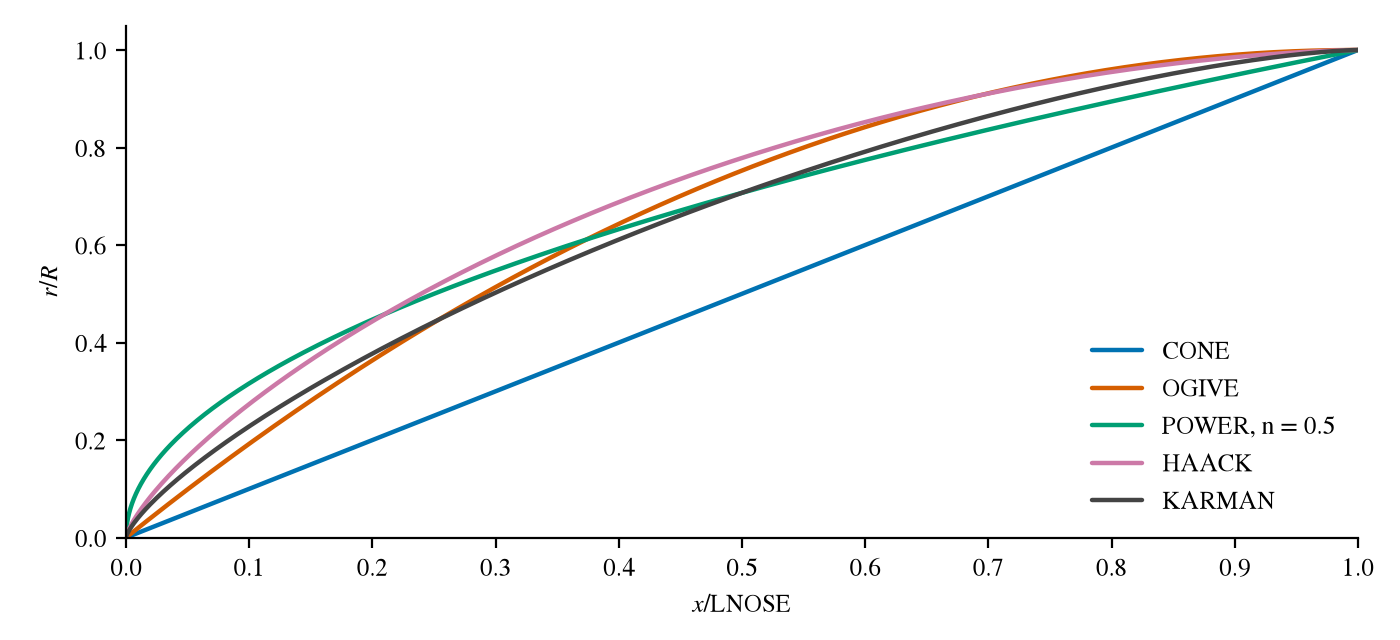
Figure 2. The five nose shapes of one length and diameter; the power law nose has exponent one-half.
The power law exponent, POWER, matters only to a power law nose, and is greyed otherwise. For an elliptical body, the nose's shape is that of the circular nose of the same width, stretched to ENOSE times as high.
An ogive is the arc of a circle. SLPNOS is the slope of the arc, the rise of its radius per unit of length, where it meets the nose base. Zero, the default, is the tangent ogive: the arc meets the base moving along the axis, as the centerbody continues. A positive slope is a secant ogive, whose arc meets the base at an angle; it is flatter than the tangent ogive, and the cone, whose slope is that of the line from the tip to the base, is its limit (0.167 for the noses of Figure 3). A slope larger than the cone's makes a nose that curves in toward the axis, and one larger than about twice it makes a nose whose arc crosses the axis near the tip. A negative slope makes a nose fuller than the tangent ogive, wider than its base. SLPNOS matters only to an ogive nose, and is greyed otherwise.
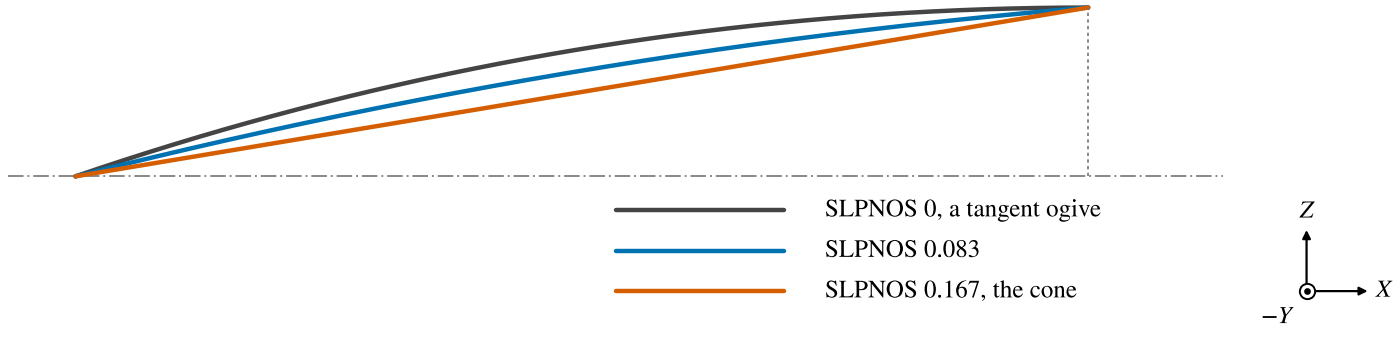
Figure 3. Ogive noses of one length and diameter with three slopes at the base, the last being the cone.
BNOSE blunts or truncates the nose (Figure 4). Without TRUNC, it blunts the nose with a sphere of radius BNOSE whose front is the tip, so the tip is rounded and the nose keeps its length LNOSE and its base. A cone or ogive is drawn from the base to touch the sphere. A power law, Haack or Von Karman profile is drawn from a virtual tip, ahead of the tip or just behind it, placed so that the profile touches the sphere. A power law nose of exponent one-half is already as round at its tip as a sphere of radius , so no profile of it touches a smaller sphere, and such a nose stays sharp. A smaller exponent is blunter still and stays sharp under larger spheres: with exponent 0.3 a sphere needs a radius of about 0.45 of the base radius. A sphere as large as the nose base is met by the straight line from the base that touches it, as on a cone. With TRUNC on, BNOSE instead cuts the nose off flat, at a face of radius BNOSE at the tip, and this is so for every shape of nose. For an elliptical body BNOSE is measured across the width, and the sphere or face is ENOSE times as high.
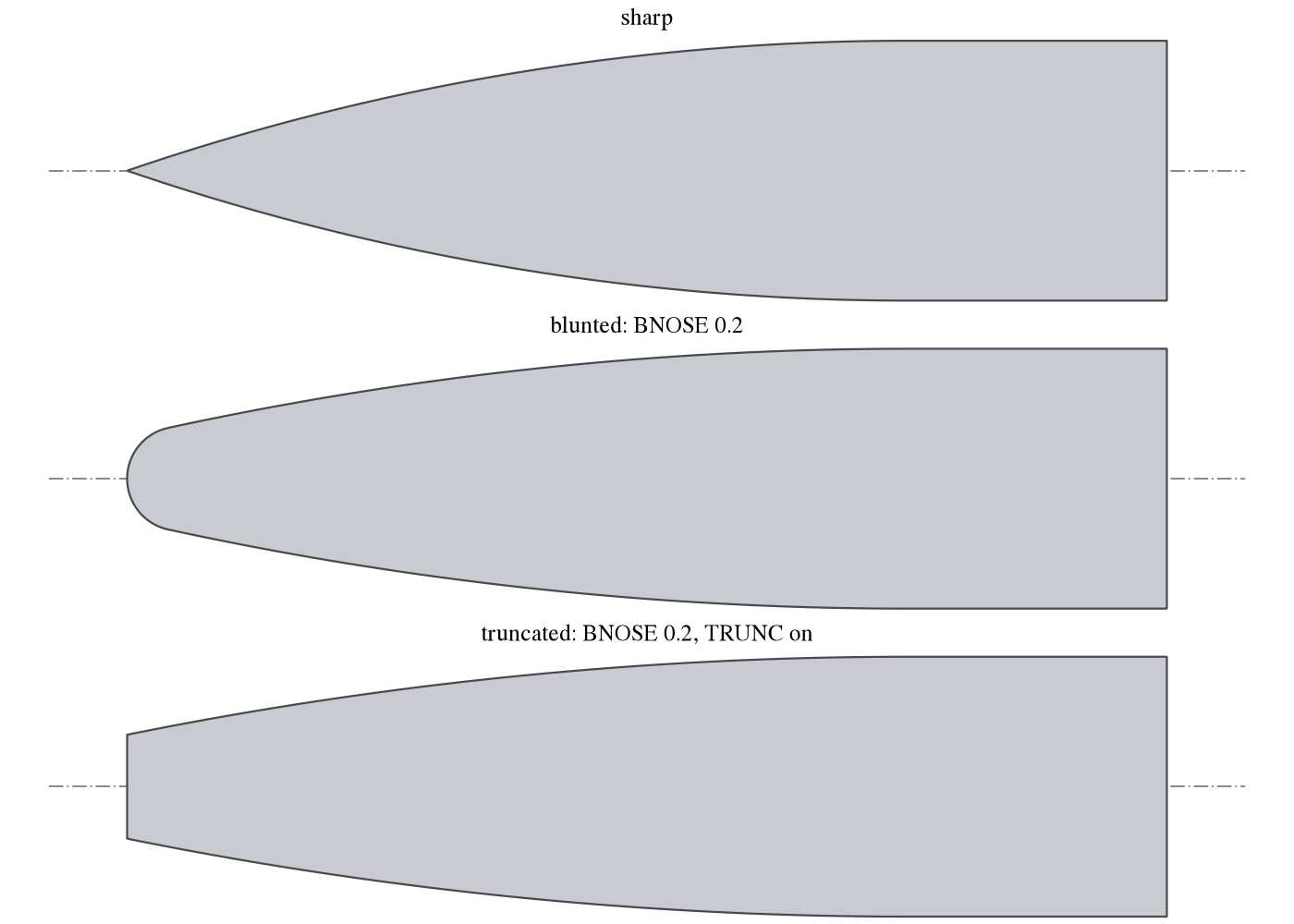
Figure 4. An ogive nose sharp, blunted by a BNOSE of 0.2, and truncated by a BNOSE of 0.2.
The centerbody is a cone frustum from the nose base to its aft end, of length LCENTR and size DCENTR there. The aft body, LAFT long and DAFT across at the base, is a cone, or with TAFT set to OGIVE, an ogive (Figure 5). Its ogive is the arc of a circle through both ends, and SLPTAL is its slope where it meets its larger end, positive toward the axis: the forward end of a boattail, and the base of a flare. Zero, the default, is tangent to the larger end there, and a positive slope is a secant ogive. On a flare, a slope at the base more than twice the straight flare's makes an aft body that first narrows below the centerbody. SLPTAL matters only to an ogive aft body. DATCOM requires DAFT to differ from DCENTR; here it need not.
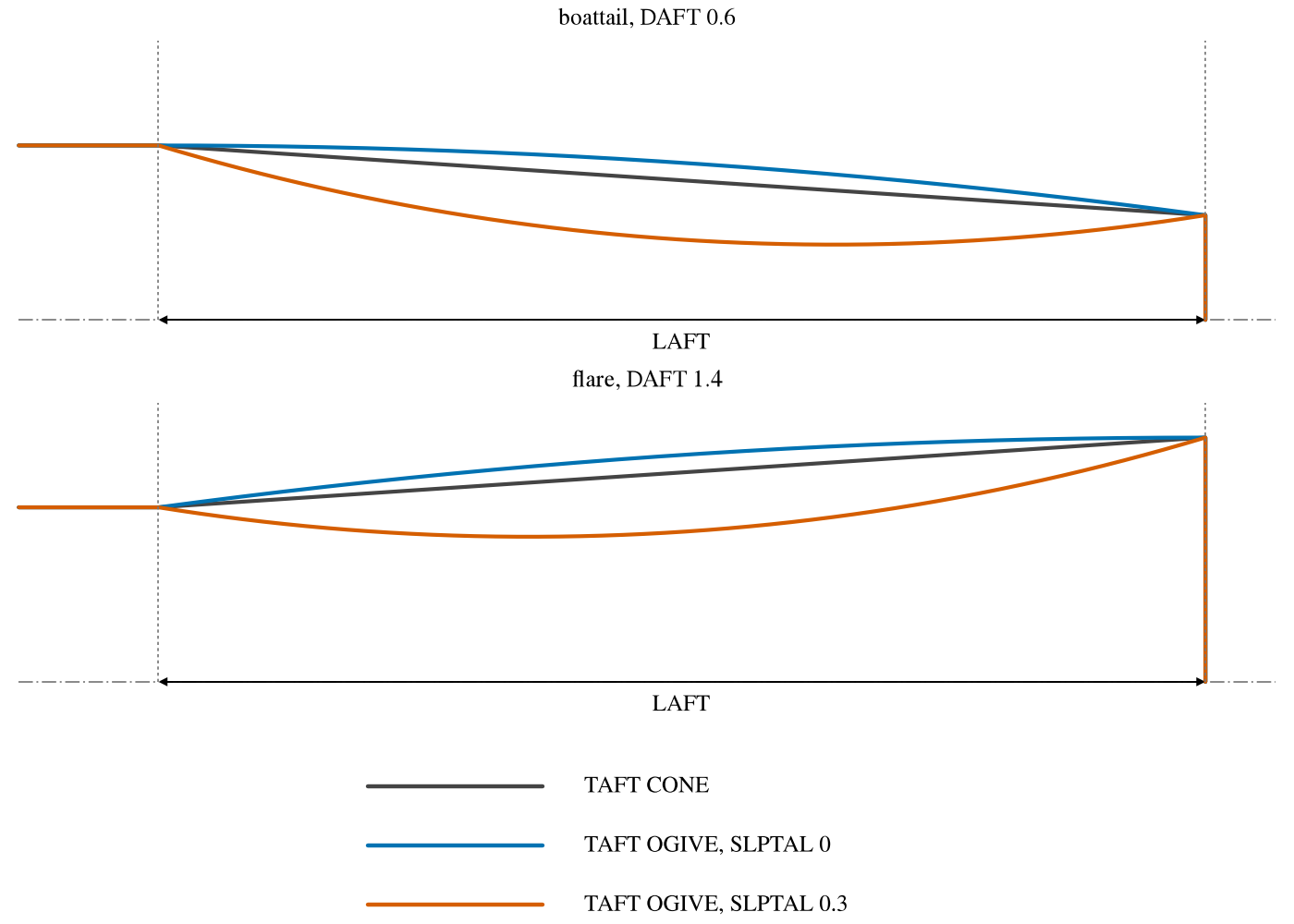
Figure 5. A boattail and a flare, each a cone and two ogives. Both bodies have the same nose and centerbody.
The base is flat. DEXIT, the diameter of a nozzle's exit, which DATCOM takes for the base drag, is drawn in it as DATCOM draws it: the base is flat from its edge in to a circle DEXIT across, and from there a cone goes in to a point a quarter of DEXIT inside the base. An exit as large as the base leaves no flat ring, and one larger is taken to be the base's size. Zero, the default, is a flat base. A nose alone has no base to cut, and its DEXIT is greyed.
With NAMELIST ELLBOD every section is an ellipse. Its width is WNOSE, WCENTR or WAFT, and its height is the ellipticity, ENOSE, ECENTR or EAFT, times the width (Figure 6). An ellipticity under 1 is wider than tall and over 1 is taller than wide, and the sections may be mixed along the body. The ellipticity is the same for the whole nose, whatever its shape. It does not carry from one part to the next: ECENTR and EAFT are 1 by default, so a body that is wider than tall throughout needs each of the three set. The inputs of the other namelist are greyed: DNOSE, DCENTR and DAFT for ELLBOD, and the widths and ellipticities for AXIBOD. The diameters and the widths are kept equal, each following the namelist chosen, so changing the namelist changes the body as little as it can: an AXIBOD becomes an ELLBOD as wide as it was, and the ellipticities, kept while AXIBOD is chosen, make it elliptical again.
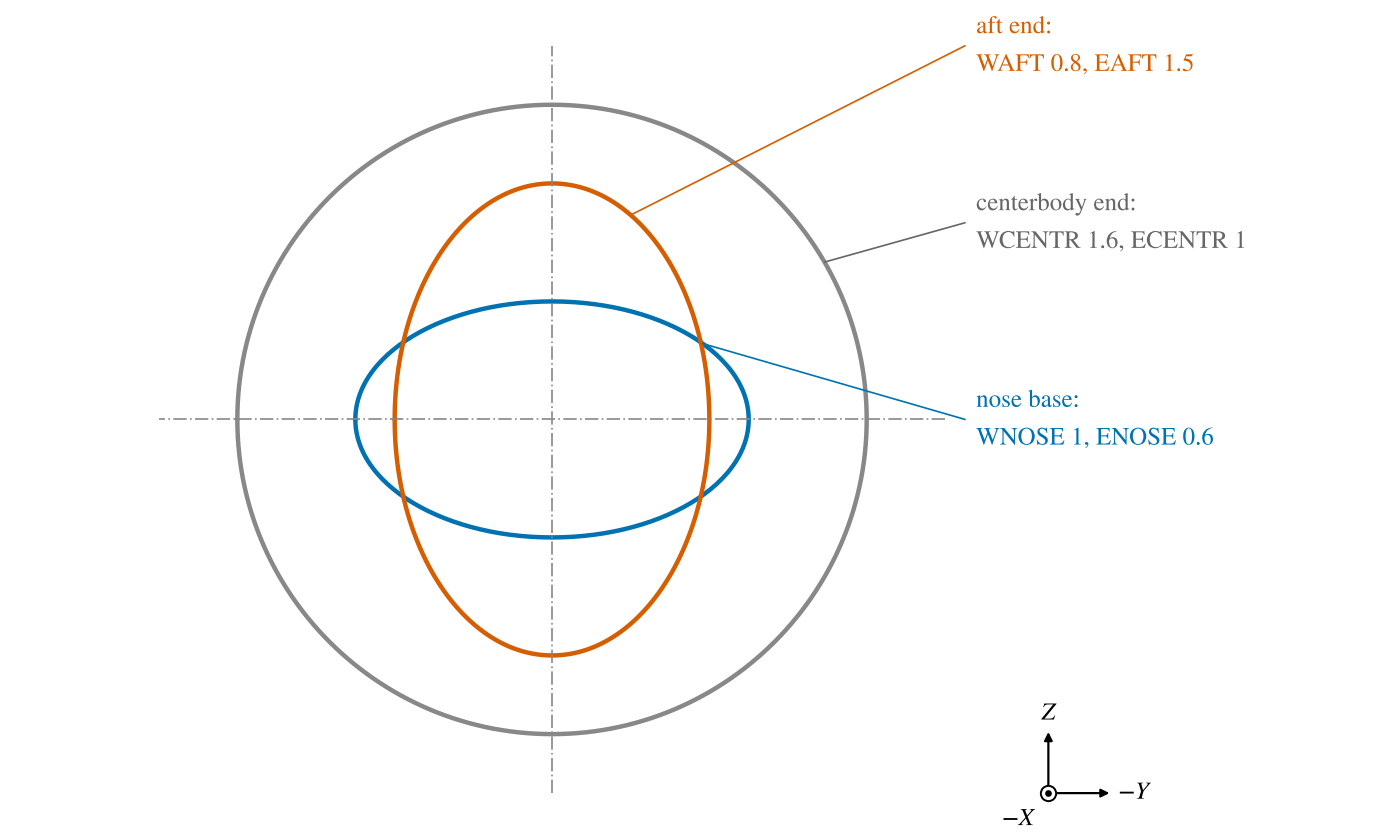
Figure 6. Sections of an elliptical body at the nose base, the end of the centerbody and the aft end.
ZTIP, ZNOSE, ZCENTR and ZAFT bend the body upward, as DATCOM does, by shearing: each section is moved up without turning, by a distance that is linear between the stations where it is given (Figure 7). They are given at the nose tip, the nose base, the end of the centerbody and the aft end, all zero by default. The body is made uncambered, from the other inputs, and then moved, so camber does not change any section. Where the centerbody or aft body is absent its camber is greyed.

Figure 7. A cambered body: the centerline passes through the heights ZTIP, ZNOSE, ZCENTR and ZAFT.
The rows along the body are set part by part, by the Num_U slider at the top of the Nose, Centerbody and Aft Body sections; the Gen tab's Num_U is greyed, and its Num_W sets the rows around the body as for any component. The nose's Num_U also sets the rows across a flat base, and the aft body's those across a nozzle exit. A part that is absent has its Num_U greyed.
Put the rows where the body curves. A curved nose needs the most, and more still where it is blunted. The centerbody and a cone aft body are straight along their length, so their two end rows give their shape exactly, and more rows only make a finer mesh for an analysis that wants one.
The Convert to Stack button at the top of the Design tab makes the
equivalent Stack, a Stack of the same
body. It asks whether to replace the MDC_BOD or add a Stack beside it.
Replace swaps the MDC_BOD for the Stack, which takes its place in the
model, and cannot be undone; Add leaves the MDC_BOD as it is and adds
the Stack. A Stack has the controls of a general body, so convert when
the body needs sections an MDC_BOD does not have. Where the body is
cambered across an ogive aft body, the Stack is a small distance from it
that grows with the camber, about 0.005 of the diameter for camber of a
fifth of it. Each of the Stack's sections takes the rows of the part it
is in, and its cap tessellation, which a Stack uses at both ends, is the
nose's, so the Stack is tessellated as the MDC_BOD is. The API call
ConvertMdcBodToStack does the same.
The parms are in the Design group but for XO, which is the XForm tab's X location, and the three Num_U, which are in the Shape group. The first column gives the Design tab's section.
| Section | Control | Parm | Default | Meaning |
|---|---|---|---|---|
| Body | Preset | Preset |
Default | The shape Set gives: Default or Generic Rocket. |
| Body | NAMELIST | NAMELIST |
AXIBOD | AXIBOD, circular sections, or ELLBOD, elliptical sections. |
| Body | XO | X_Rel_Location (XForm) |
0 | Position of the nose tip along . |
| Nose | Num_U | NoseTess_U (Shape) |
9 | Rows along the nose, and across a flat base. |
| Nose | TNOSE | TNOSE |
OGIVE | CONE, OGIVE, POWER, HAACK or KARMAN. |
| Nose | POWER | POWER |
1 | Exponent of a power law nose. |
| Nose | SLPNOS | SLPNOS |
0 | Slope of an ogive nose at its base; zero is tangent. |
| Nose | LNOSE | LNOSE |
3 | Length of the nose. |
| Nose | DNOSE | DNOSE |
1 | Diameter at the nose base (AXIBOD). |
| Nose | WNOSE | WNOSE |
1 | Width at the nose base (ELLBOD). |
| Nose | ENOSE | ENOSE |
1 | Height over width at the nose base (ELLBOD). |
| Nose | BNOSE | BNOSE |
0 | Radius of the blunting sphere or of the truncated face. |
| Nose | TRUNC | TRUNC |
off | Truncate the nose rather than blunt it. |
| Nose | ZTIP | ZTIP |
0 | Camber at the nose tip. |
| Nose | ZNOSE | ZNOSE |
0 | Camber at the nose base. |
| Centerbody | Num_U | CentrTess_U (Shape) |
9 | Rows along the centerbody. |
| Centerbody | LCENTR | LCENTR |
7 | Length of the centerbody. |
| Centerbody | Nose's size | CENTRDefault |
on | The centerbody's size at its aft end is the nose's. |
| Centerbody | DCENTR | DCENTR |
1 | Diameter at its aft end (AXIBOD). |
| Centerbody | WCENTR | WCENTR |
1 | Width at its aft end (ELLBOD). |
| Centerbody | ECENTR | ECENTR |
1 | Height over width at its aft end (ELLBOD). |
| Centerbody | ZCENTR | ZCENTR |
0 | Camber at its aft end. |
| Aft Body | Num_U | AftTess_U (Shape) |
9 | Rows along the aft body, and across a nozzle exit. |
| Aft Body | TAFT | TAFT |
CONE | CONE or OGIVE. |
| Aft Body | SLPTAL | SLPTAL |
0 | Slope of an ogive aft body at its larger end; zero is tangent. |
| Aft Body | LAFT | LAFT |
0 | Length of the aft body. |
| Aft Body | DAFT | DAFT |
0.8 | Diameter at the base (AXIBOD). |
| Aft Body | WAFT | WAFT |
0.8 | Width at the base (ELLBOD). |
| Aft Body | EAFT | EAFT |
1 | Height over width at the base (ELLBOD). |
| Aft Body | ZAFT | ZAFT |
0 | Camber at the base. |
| Base | DEXIT | DEXIT |
0 | Diameter of the nozzle exit, drawn as a cone into the base. |